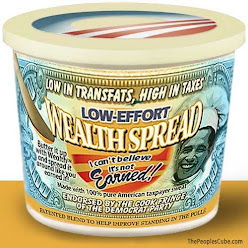
What is the value of liberty to you? Is it worth the price of a government check?

Thursday, February 28, 2008

McCain v Obama: Economics & Taxation

Next we will look at the distinctions between McCain and Obama on economic policy and leadership.

Much has been made during the Republican primary process about McCain’s admission that a personal understanding of economics is not his strong suit. Appropriately so. However, it’s not hard to look at the general approach to economic policy that characterizes the two parties, as well as the voting record of McCain vs. Obama on economic issues.

Since Barack Obama had the most consistently liberal vote in the US Senate last year, we should consider the general liberal/progressive view of taxation and economic issues. Because the liberal political philosophy focuses on large-scale government solutions to problems, which costs money, liberals are often forced/pressured into increased taxing to pay for these programs. They will generally vote against tax cuts. And they generally prefer to really crank up the taxes on the “wealthy” and you hear "class warfare" rhetoric from liberals constantly (think of John Edwards' "two America's" lines).

McCain voted against President Bushes tax cuts early on, but says it was because legislators were not willing to cut expenses at the same time. Overall, though, he has a record of preferring tax cuts and avoiding tax increases and has made such a pledge if he becomes president.

And on the other side of the ledger he's one of the best Republicans around at working to limit government growth and spending and deficits. He could be one of the best Presidents ever in this very important ongoing effort.

Occasionally you will note that I am still in mourning over Mitt Romney. The economy was and is his strong suit. McCain doesn’t have any particular personal advantage or skill in this area, but his principles are strong and generally market oriented. The liberal agenda I don’t believe to be particularly good for the economy. However, either person as president will get advice from people who are more skilled and knowledgeable than they are.

I see this as a matter of tax policy as much as anything as well as "larger government" vs. "limited government" and I strongly prefer McCain’s approach to Obama's.

Monday, February 25, 2008

McCain v Obama: War on Terror

Now let’s tackle what will be one of the two top issues which will define the differences between the two parties and between the two candidates this fall: the War on Terror, including it’s Iraq component.

Both candidates say, for the record, that protecting Americans and the world from the assaults of terrorists is important. That’s where the agreement ends. The differences begin with the overall assessment of the level of importance and priority that should be assigned to this conflict.

Since Obama has shown exactly zero inclination to differ from his party on this issue, I will present his side based not only on Obama’s own statements, but the general position of Democratic Party leaders.

For Democrats, I believe it is fair to state their position on the problem this way: “Although 9/11 was a national tragedy, and radical Islamists certainly would like to harm us, we don’t believe it represents a mortal threat to the United States; in fact, we would not even call it a “war” because that just invites conflict and causes people to hate America more than they already do. It’s not worth all the blood and treasure we have spent on the conflict so far. There are other, more pressing priorities for us: stopping global warming, reducing poverty, giving everyone health care and expanding other government entitlements.”

For Republicans and John McCain, I would state it this way: “On 9/11, it became clearer than ever that we face a threat in radical Islamic jihadism that has the potential to destroy much of what America is and represents in the world. They are by nature a cult of death, and intent not so much on building something positive, but rather destroying Western society and particularly the United States. They have shown no signs of self-restraint in what they are and would be willing to do to achieve their aims. If they had a functioning nuclear bomb in their hands today and the capability of detonating it in downtown Manhattan, they would do so in a heartbeat. They have a global network with the determination and patience and resources to potentially achieve their aims. If the United States is not willing to lead the world in a focused and determined way to root out these terrorists and bring them to justice, we will with certainty be hit again and again, and it will have serious long term consequences for the cause of freedom and security in the world.”

Where Barack Obama has said that his principle goal would be to get us out of Iraq within a year as his main priority, John McCain has said that his goal would be to continue to learn and adjust so that we may be more effective and able to win in Iraq and achieve our aim there of having a stable ally, able to maintain its own internal security, and with a functioning representative democracy in an area of the world that has never had this before in its history.

Barack Obama has placed himself in a position where if things continue to improve in Iraq, it proves him wrong. That is, if America succeeds, he loses. Why would he not instead focus on how we can best succeed there, instead of how we can cut our losses and leave as soon as possible?

Obama’s position also has the practical effect of demeaning the tremendous physical and emotional sacrifice and courage of our soldiers, sailors, and airmen in Iraq. After all they have done, and with things improving and the achievement of our goals a real possibility, why would he be so willing to give those things up – just to avoid further sacrifice? And his position also has the practical effect of emboldening our enemies. Say you are an anti-American jihadist in Iraq. Would you not feel great satisfaction and joy to know that if Obama wins, it will just be a matter of a relatively short time before you will have freer rein and before you can gleefully proclaim to the world that you beat the Americans? And you would be able to plan and strategize with more certainty…just lay low, let the Americans leave, then attack. Why would a potential president of the U.S. do this? Why would they not at least say, “look, we would like to reduce troop levels and I believe we can…we will simply demand that the Iraqis take up the slack, but we will be vigilant and change these plans if the situation warrants it.”

John McCain will be as strong as President Bush in the prosecution of the war, but I suspect will be wiser and more sure in his approach. He has been willing to criticize tactics in Iraq and the general war on terror, and his criticisms have in retrospect been pretty much spot on. He certainly would not give the terrorists any comfort should he be elected.

Saturday, February 23, 2008

McCain v Obama: Leadership

The third area of contrast I would present between McCain and Obama is in what we know about their leadership ability. I think it’s fair to say that the summation of all Obama’s resume of high-level leadership experience is this: he has run some effective political campaigns and been elected to office. He has served as a leader in the Illinois state legislature, and is just into his second term in the U.S. Senate. That to me is a fairly thin portfolio for the person who would be leader of the free world. (I will avoid here the temptation I feel to regret the fact that we lost out on the candidate with the strongest and most compelling leadership experience resume: Mitt Romney…[sigh]…)

However, I will give him this aspect of leadership ability: he is inspiring and can capture an audience. This is one very important element of leadership, but of course not the only important element.

John McCain, in contrast, has been a leader of men in the military, has also led many successful political campaigns, and has been a political leader of a number of political causes. And although there are a number of those political causes which I personally disagreed with him on, there’s no question he has a lot more political courage than most, as he has shown a willingness to take on both political friends and political enemies for those causes. If you want a President with political backbone, who is willing to stand on principle rather than polls and popularity, then John McCain is clearly your man.

Barack Obama has not shown a similar inclination to act on principle rather than party, in that he has been perhaps the most consistent party-line and liberal vote in the Senate, as evidenced by his ranking as 2007's "most liberal senator" based on a liberal think tank ranking. If it really has been his principles rather than party affiliation that have led to this record, then he certainly is not in the American mainstream in his beliefs and policies. As conservative columnist Charles Krauthammer noted in a Jan 13th 2008 article: “The freest of all passes to Obama [from the media] is the general neglect of the obvious central contradiction of his candidacy—the bipartisan uniter who would bring us together by transcending ideology is at every turn, on every policy, an unwavering, down-the-line, unreconstructed, uninteresting, liberal Democrat. He doesn’t even offer a modest deviation from orthodoxy.”

Friday, February 22, 2008

McCain v. Obama: Communication Skill

[Quick note: I should have said this from the start of this series of posts just to make it perfectly and forthrightly clear: I do not favor one of these candidates over the other based on their race, their gender, their age, or their particular religion. I would favor one over the other only due to differences in policies, ability, skills, and character. If Condoleeza Rice was running for the Republicans, I would vote for her in a second. If Senator Harry Reid (a Mormon, and current Senate Majority Leader) were running for the Democrats, I’m sure I wouldn’t vote for him. For the Democrats, “identity politics” based on voting for or against someone based on whether they are a member of “your racial/gender group” has been an issue (particularly in this primary season, it seems). For Republicans, gender and race and age don’t seem to matter so much, but apparently for some, their religious affiliation does (i.e. for some who voted against Romney at least in part due to discomfort with his being Mormon), though these appear to be a fairly small minority.]

[UPDATE: Based on input from a friend, let me clarify also that I don't mean to impugn Democrats or Republicans as a whole in the above statement; I was really more thinking of this campaign season along with some of the recent histories of the parties where some of these group identity issues have played a role. This point has been made by numerous mainstream media sources and bloggers based on exit polling.]

Now let’s consider the differences between John McCain and Barack Obama in communication skill. Despite all the advantages I see for McCain compared to Obama, this is an area where Obama has a crushing advantage. Obama is compelling to listen to. His rhetoric is inspiring. McCain too often sounds like…well, a stodgy old Senator. I’m not saying McCain can’t be compelling too, because he can be. But hand it to Barack…he’s very good in this area.

However, there are two issues I have here. 1) At least so far, Obama hasn’t said very much. That is, he says the same things over and over and over. It is great stuff, but once you’ve heard it a time or two, it becomes less compelling. 2) Action is needed, not just words. I do not agree with the criticism suggested by Hillary Clinton and other Obama critics that it’s “just words” or that words don’t matter much. As Obama rightly suggested in response, words can mean a lot and are very important. However, words alone do not cut it. It’s one thing to inspire people as John Kennedy did with “ask not what your country can do for you, but what you can do for your country.” It’s another thing to do something or act on that inspiration.

What you really want is someone who can say the words that inspire and in a way that inspires, but who can then also translate it into effective action. That is, you want a Ronald Reagan who could say “Mr. Gorbachev, tear down this wall!” but could also build up the military and a more focused and strong foreign policy to cause the Soviet Union to implode internally which in turn led to that wall coming down.

Unfortunately, we don’t appear to have a Ronald Reagan running this year. You have Obama’s inspiring words but with almost nothing to show for it, and you have McCain’s more limited ability to communicate and inspire, but with significant practical experience in getting things done in Washington. Since we only get one of the two, you decide what’s more important.

Thursday, February 21, 2008

Obama's Religious Background

One of my friends on my e-mail list asked me to look into the e-mail rumors that have made the rounds regarding Barack Obama's religious background and affiliation. The claim/statement suggests that Obama was born Muslim and retains that affiliation, and suggests that he avoids pledging allegiance to the United States and would take the oath of office on the Koran rather than the Bible.

What I've found suggests this is not true. For details, click here. What appears to be the case is that Obama's father (for whom he is named) grew up Muslim in Kenya, though by the time he met and married Barack's mother at the University of Hawaii he was not a practicing Muslim, and in fact was more agnostic. Barack's mother (white and from Kansas) was also pretty much agnostic, though she had sort of an anthropomorphic fascination with the variety of world religions and taught this sort of intellectualized religious background to Barack as a child. Barack's father left his mother and they divorced when Barack was 2. Later, his mother married another Muslim man, which is why Barack lived for a time in Indonesia. Indonesia is of course a predominantly Muslim nation, but his mom picked his schools more based on the quality of education than their religious affiliation, so he also attended a Catholic school for a couple of years. He then was sent back to the U.S. to live with his maternal grandmother.

Barack himself appears from my reading to have accepted, along the lines of his mother, more of an intellectual view of religion. Obama as a young adult also apparently struggled with his racial identity to a degree, and I think began to identify more and more with the African American community. He made his place and his early political career in the Chicago area.

It appears that as he became more involved in the African-American community in Chicago, he saw how important the Christian churches had been to the black community historically, and also how involved they are today in striving to address the social problems of poor inner city blacks. This seemed to deepen his respect and feeling for Christianity, and he identifies himself as a Christian, or as he puts it, he says he is now "rooted in the Christian tradition." Certainly he has stated that he does pledge allegiance to the United States with his hand over his heart regularly, and he would take the oath of office with his hand on a Bible.

What I don't know is how involved he is in his church on a formal basis, or what his private religious practices are, but at least he claims to be a believing Christian.

The one other aspect of his religious affiliation that does trouble me somewhat, is that the pastor of the church he has belonged to in Chicago
(Rev. Jeremiah Wright) has made statements saying that their "theological perspective starts from the vantage point of Black liberation theology being its center." This is a link to their web site discussing this issue here. Despite their explanation, any time someone centers their ideas on a racially exclusive basis, it bothers me. I haven't heard Obama speak to this point directly, so I don't know for sure what his own thoughts and feelings on this are. I imagine he would not condone these views, but it's strange to me that he would attend and affiliate with a church and pastor like this.

McCain v. Obama: Experience

Now that it is shaping up to be a competition between John McCain and Barack Obama, let’s start contrasting the two candidates. This will be the first of a number of looks at points of contrast between the two.

Here is a brief outline of a few of the contrasts we will look at:

  • Experience
  • Communication
  • Leadership
  • War on Terror
  • Economic Leadership
  • Role of Government
  • Proud to be an American
  • Identity Politics
  • The Constitution and the Courts

Let’s begin with one of the more obvious differences between the two: their age and experience. Clearly there is some advantage and certainly much enthusiasm, about having a young and vibrant candidate like Obama. It’s the enthusiasm of a new approach, new verbiage in the sound bites from the candidates, etc. This is the appeal of Barack Obama. You can see it and sense it in the noise level and appearance and size of the crowds at Obama rallies. He talks about inclusion, hope, and enthusiasm to tackle new and old problems alike.

The contrast in style to both Hillary Clinton and John McCain is quite dramatic, and I think it certainly works against them.

John McCain, on the other hand, embodies experience and battle-tested wisdom. Where Obama’s main claim to personal hardship is having grown up largely without his father being a part of his life, John McCain endured and suffered as a prisoner of war in Vietnam. McCain has served his nation, laying his life on the line serving in the military, and since then has continued to serve in public office, with all the personal sacrifices that demands.

Obama can talk about and debate America’s role in the world. McCain can often speak from experience, which can be a very powerful thing.

Obama's career in total is: served for years in the Illinois legislature, and now one term as U.S. Senator. McCain's career includes about three decades of work in Washington, including a long stretch in the U.S. Senate.

So there it is: youthful enthusiasm without experience, or aged wisdom, battle-tested. Since the former looks better on television and in sound bites, what will American's seek? What will you or I seek?

Wednesday, February 20, 2008

McCain Nears Goal, Obama on a Roll

John McCain won in Wisconsin and Washington state, pushing his delegate totals close to the number needed to secure the nomination. If you include Romney's delegates, who he has asked to support McCain, he is over the top.

However, if you want an indication of how the "Republican base" is still feeling about McCain, just look at the results from Washington. Romney, despite having pulled himself out of the race, nearly beat Huckabee for second place there, and if you combine the totals of the two, they had nearly as many votes as McCain did. McCain clearly has a lot of work to do.

Obama continues his roll. Technically Hillary can win in Texas and Ohio and still win the thing, but my sense of it is she is sliding and I suspect will lose one or even both of those, and the thing will swing to Obama.

We should have a pretty fair sense in the next week or two if I'm right here, then it will be "game on" between McCain and Obama.

Tuesday, February 19, 2008

Bush 41 Adds His Endorsement

McCain continues to work on establishing unity in the Republican Party to support him this fall. The elder and former President Bush added his endorsement yesterday. These are good steps and needed.

These things take time. I still feel at present that I don't particularly like John McCain, but of the available options see him as our best option for strong leadership at a time of great national peril.

Clinton is a disaster. Obama is likable and great at the sound bites. Unfortunately thus far is almost a hollow shell in terms of showing us any substance or specifics. How do you choose a guy for president who isn't willing to be specific about anything or tell us precisely what he would do in the White House? As McCain suggested, platitudes just don't cut it when we're talking about the leadership of the free world. This isn't, or shouldn't be, a popularity contest.

Friday, February 15, 2008

Marvelous Statement from K-Lo

I add my "amen" to this article by Kathryn Lopez of the National Review:

"What a breath of fresh air the Romneys on the public stage have been. Way too often in pop culture, men are portrayed as dopes; think about just about any sitcom. The dad/husband is portrayed as a doofus. What’s wrong with having somebody in public life who’s like Mitt Romney — a capable, experienced executive who loves his country and also happens to be a God-fearing father and husband? That’s not a bad thing for Americans to see. Forgive him for being easy on the eyes.

And I’ll go one step further. I worry about a political culture that is a little too suspicious of a scandal-less, all-American-gee-whiz-this-is-the-American-dream-in-overdrive package. We should be glad that good people — who, while well-off, are not without their share of painful crosses — are willing to subject themselves to the ugliness that politics can inflict. We should be grateful that good families will make the sacrifices necessary to serve — and make those sacrifices with no guarantees they’ll succeed."

Thursday, February 14, 2008

Romney's Endorsement of McCain Today

Governor Romney threw his support behind Senator McCain today, in another gracious and honorable act that I think reflects favorably on his character. The NY Times article on this is quite good.

During this campaign (as well as previous ones), I believe we have seen John McCain's weaknesses quite clearly...and I won't pretend that I'll forget them. But I also recognize three things. One is that he does have significant strengths. Two is that nobody is perfect and we need to be able to be forgiving at times even in politics. And three is that, as I reviewed in the post below, there are at least two issues that I consider of the utmost significance to our nation, which the election in November will impact on greatly: the War on Terror, and the Supreme Court. And on these two points, the difference between John McCain and the Democrats is vast.

If it were not for this last point, I would consider other options, since McCain has certainly shown himself to be non-conservative, even liberal, in some key areas. But this is not the time for that. Those issues are too important.

On a different note, I also believe that this is another part of Mitt Romney's process of building the support he will need to make another run--a successful run--for the White House in 2012. Political parties are not perfect, but they are powerful. It is the way we in America join together in a cause with others, even though we do not all agree on all points. It allows us to help important changes to occur, and to be able to unite behind our national leaders. Romney recognized, more than any other Republican candidate, how important this principle was and is. It is a principle that Reagan understood well. The "Reagan Coalition" of fiscal/economic, social, and national defense conservatives is based on this principle.

Romney's dedication to this important coalition building helps McCain and the Republicans now, and in turn should help him when he runs again for the presidency.